From Data-Driven to Data-Inspired: Why Context Is the Missing Ingredient for AI
For years, organizations have invested heavily in data. They’ve built warehouses, dashboards, lakes, governance programs, and AI initiatives – all with the goal of becoming “data-driven.”
Yet despite those investments, many organizations still struggle to realize meaningful business value from AI.
Why?
According to Dr. Sebastian Wernicke, economist, AI thought leader, and author of Data Inspired, the problem isn’t that organizations lack data. It’s that they’re often solving the wrong problem.
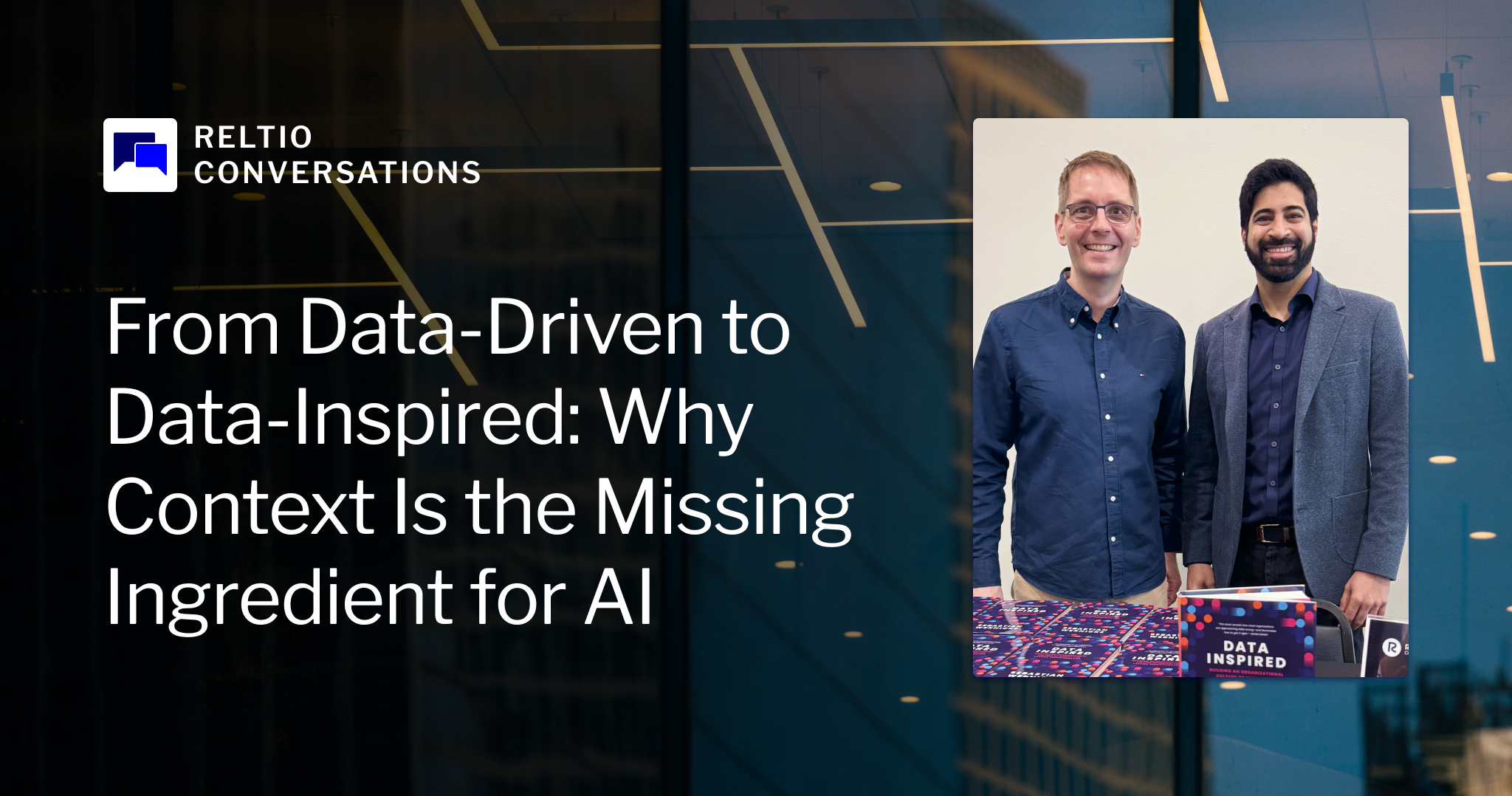
In a recent edition of Reltio Conversations, Reltio Vice President and Field CTO Kash Mehdi sat down with Wernicke to discuss why the next generation of AI success won’t come from larger models or more data, but from better leadership, stronger data foundations, and richer business context.
Watch the conversation here:
The real data problem isn’t technology
When organizations begin their AI journey, the first instinct is often to focus on technology. Which model should we use? Which platform should we buy? Which AI applications should we deploy?
Those questions matter, but they’re rarely the hardest part.
“The technological challenges are real,” Wernicke explained, “but the cultural challenges are often even bigger.”
Organizations have known for years that data is valuable. Every new technology wave – from big data to machine learning to generative AI – has reinforced the same lesson: AI is only as good as the data behind it.
The difference today is that AI has dramatically raised the stakes.
Technology alone doesn’t create business transformation. Leaders must also create incentives that encourage employees to treat data as a strategic asset, involve business stakeholders early, and build cross-functional ownership around data initiatives. Without that cultural alignment, even the most sophisticated AI programs struggle to deliver lasting value.
Start with purpose – not AI
One of the strongest themes throughout the conversation was the importance of reversing how organizations approach AI.
Too often, executives declare that “AI is our strategy.”
But AI isn’t a strategy.
A strategy begins with business outcomes.
Do you want to improve customer experience? Increase revenue? Reduce risk? Accelerate product innovation? Enter new markets?
Once those objectives are clear, AI becomes an enabler – not the objective itself.
As Wernicke noted, organizations should first define where they want to go as a business and then determine how data and AI can help them get there. That simple shift keeps AI initiatives tied to measurable business value instead of becoming isolated technology experiments.
Why AI needs context – not just data
As the discussion shifted toward agentic AI, Kash Mehdi highlighted a challenge many organizations are beginning to encounter.
Today’s AI systems often connect to individual applications or isolated data sources. That allows them to answer questions – but not necessarily understand the business.
Fragmented data produces fragmented intelligence.
Organizations need something more: a trusted layer of business context that connects customers, products, suppliers, transactions, policies, and relationships into a complete picture of the enterprise.
This is where Context Intelligence becomes essential.
Without context, AI agents can still produce answers – but they may confidently make poor decisions because they lack the relationships and business meaning that human experts naturally understand. As Wernicke observed, agents rarely stop and admit they don’t know enough. They simply make assumptions, making trusted, connected data even more critical.
The shift from analytics to autonomy
For decades, analytics helped people make better decisions.
The emerging era of agentic AI changes that equation.
Increasingly, AI agents will participate in – or even execute – business decisions autonomously.
That represents a fundamental shift.
Rather than asking whether a dashboard helps an employee make a better decision, organizations must ask whether an AI agent has enough trusted information to make the right decision on its own.
That means documenting institutional knowledge, defining business entities consistently, capturing relationships between data, and making tacit expertise machine-readable.
As Kash noted during the conversation, organizations must think carefully about what their AI agents are actually “thinking on.” Context becomes the operating system that enables autonomous decision-making at enterprise scale.
From optimization to transformation
Perhaps the most thought-provoking part of the conversation was about how organizations use data.
Wernicke shared a simple analogy.
Given a paper airplane, you can continue folding and refining it into a better airplane – or you can unfold it completely and transform it into something entirely different, like an origami dragon.
The same applies to enterprise data.
Many organizations use data to optimize existing processes. They find incremental efficiencies, reduce costs, and improve performance.
Those gains matter.
But truly data-inspired organizations use data differently.
They look for entirely new products, new business models, and new ways of serving customers that weren’t previously possible.
Wernicke illustrated this with the example of Steph Curry’s transformation of basketball. The underlying data supporting three-point shooting existed long before Curry changed the game. The breakthrough wasn’t simply discovering the insight – it was having the courage to fundamentally rethink how the game could be played.
Business transformation requires the same mindset.
Data shouldn’t only make today’s business more efficient. It should help leaders imagine tomorrow’s business.
AI success begins with strong foundations
As AI capabilities continue to accelerate, it’s tempting to believe technology alone will solve long-standing data challenges.
It won’t.
Organizations still need trusted data, clear ownership, governance, shared definitions, and connected business context.
The difference is that these foundations are no longer just supporting analytics – they’re becoming the infrastructure that powers autonomous decision-making.
The point Wernicke ended on is that AI is ultimately a scaling technology. It amplifies whatever foundation already exists. Organizations with strong fundamentals will be able to move faster and innovate more confidently. Those without them will simply scale inconsistency.
The future belongs to organizations that don’t just collect more data – but become truly data-inspired, using trusted, connected context to make better decisions, empower AI, and transform how the business operates.
