
AI models are a money pit. Here’s what to build instead.

Alex Karp, CEO of Palantir, set off a familiar debate recently: should enterprises own their AI models outright, rather than renting intelligence from OpenAI, Anthropic, and the rest of the frontier labs?
It’s become one of those questions everyone in enterprise tech has an opinion on, and the answer usually splits along predictable lines. Sovereignty-minded executives want to own their weights. Pragmatists say renting is fine.
Both sides are arguing about the wrong thing. A better question to ask would be: what’s actually worth owning, and what’s not?
An AI model looks like sovereignty at first, but starts looking like a liability not long after. It’s essentially a depreciating asset with a maintenance bill attached. Businesses would be far better off owning the loop instead.
What AI model ownership actually requires
Let’s look realistically at what building and maintaining a model entails. It’s essentially a never-ending project that demands a permanent team of ML infrastructure engineers, backed by enough GPU capacity to keep them working. Even the healthiest of enterprise budgets will struggle to meet that reality.
And the model starts losing ground the moment a frontier lab releases something better.
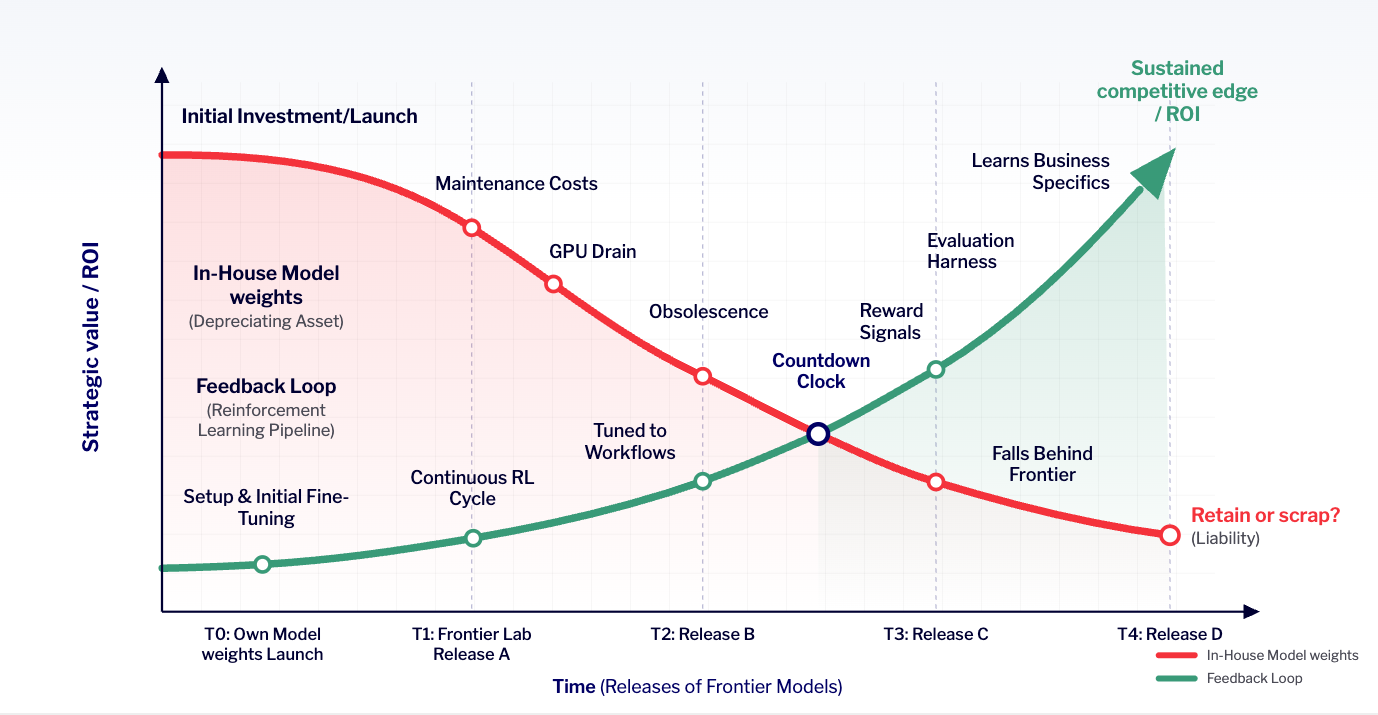
Every enterprise that pours budget into owning a model is really buying a countdown clock, not independence. The weights do not appreciate. They do not compound. They sit there, falling further behind the frontier, until someone has to decide whether to retrain from scratch or admit the sovereignty project became a liability.
The real asset is the loop
The model isn’t worth owning, but the loop is. That’s the pipeline that takes a model, points it at your specific business problems, and keeps improving it against real outcomes. The reinforcement learning cycle, the reward signal tuned to what actually matters in your workflows, and the evaluation harness that tells you honestly whether the system is getting better or just getting different.
That loop compounds in a way a static model file never can. A model depreciates the moment a frontier lab ships something better. A loop, run well, gets more valuable with every cycle, because it’s learning your business specifically.
That does not make a loop easy or cheap to run. It takes the same kind of standing team and infrastructure investment as trying to maintain a model in-house. The difference is what that investment buys you. Money spent maintaining a model buys you a slower rate of decay. Money spent running a loop buys you something that compounds. One is a cost center disguised as sovereignty. The other is closer to an actual asset.
That distinction is also why a loop is not for everyone. Many companies do not have the ML talent, infrastructure, or patience to run one well. Everyone says they want independence, but almost nobody’s checkbook agrees. It’s a textbook gap between stated preference and revealed preference.
There is a version of this that makes sense. A narrow, high-volume, well-defined workload, where a fine-tuned model can beat a generalist frontier model on that specific task at a fraction of the inference cost, is a legitimate case for building a loop. Done well, that loop becomes a genuine edge, a system that keeps getting sharper at exactly the problems that matter most to the business, in a way no rented model ever will.
Figure 1: The depreciating model vs. the compounding loop
The part even the loop-builders skip
Here is the twist, though. Even the companies with the muscle to build a real loop are often skipping the hardest part of the problem.
A loop is only as good as the information feeding it. You can have a world-class fine-tuning pipeline, first-rate infrastructure, and a talented ML team, and still be training that loop on fragmented, duplicated data that can’t tell an agent which customer record, which supplier, or which product listing is correct.
Feed a loop that kind of input, and you do not get sovereignty. You get a model that is confidently wrong, and harder to catch because it sounds plausible.
These are the prerequisites that get skipped in almost every version of this debate, and it comes before “own your weights” or “own your loop.” Do you actually know who your customer is, consistently, across every system that touches them? Do you know which supplier record is current and which one is a duplicate from a merger three years ago?
Many enterprises cannot answer that cleanly, and no amount of RL infrastructure fixes it, because the loop just learns to be wrong more efficiently.
What to do before you build anything
Strip away the sovereignty language and the debate gets simple. A model is not an asset, no matter how much budget goes into building, acquiring, or maintaining one. A loop can be, but only for the narrow set of workloads that justify the investment, and only for companies willing to run it like the standing infrastructure commitment it actually is.
Even then, a loop is only as good as what it learns from. Own your loop if the workload justifies it. But you can’t own a loop built on data you don’t trust.